Research Projects & Case Studies
Detailed engineering solutions integrating physics-informed modeling, data science, and AI for water infrastructure optimization.
Intelligent MBR Optimization via Physics-Informed Digital Twins and RL-LLM Integration
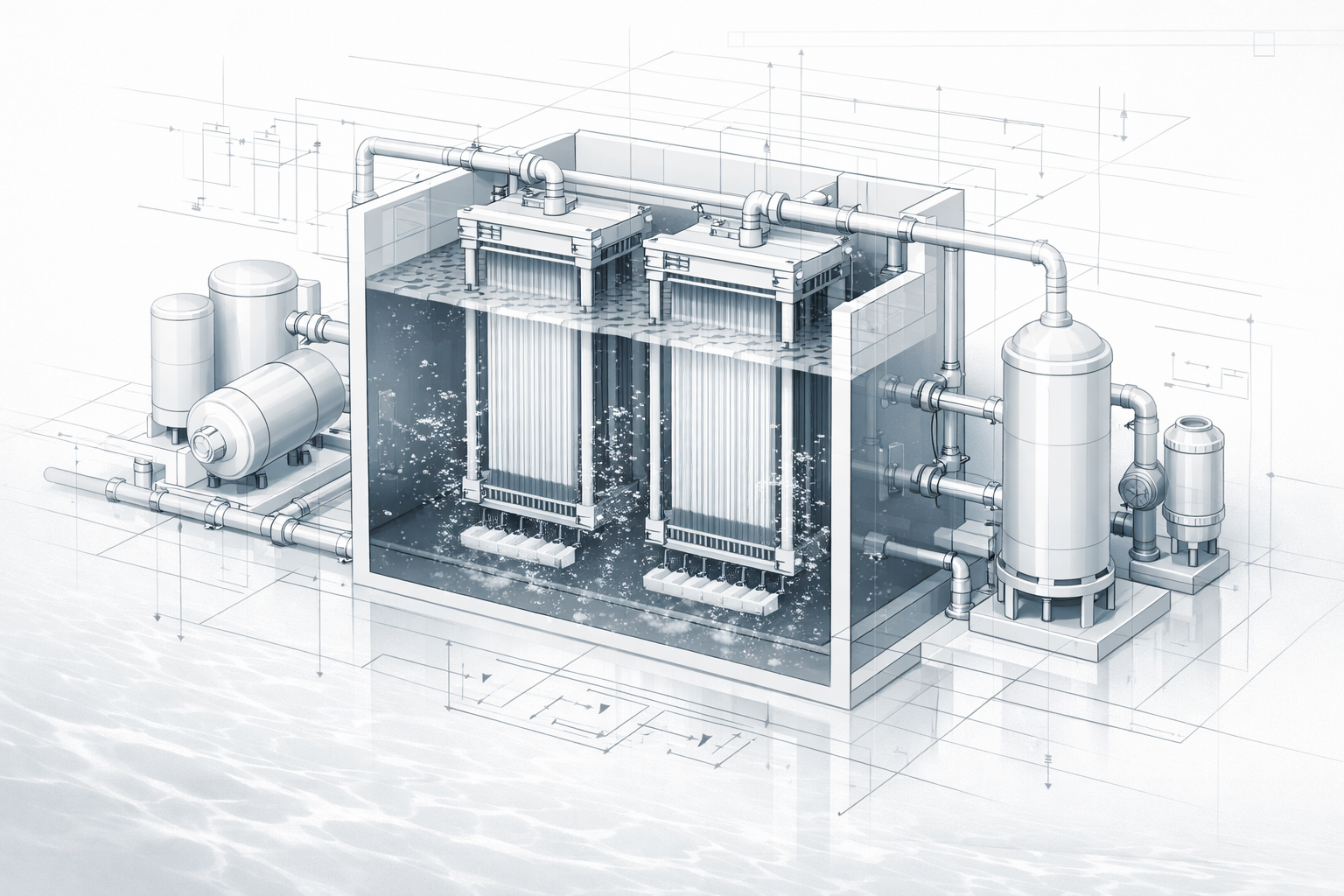
Developed a comprehensive framework for optimizing full-scale membrane bioreactor (MBR) operations through physics-informed digital twins and autonomous agentic AI systems.
Ongoing
2020 – 2025
University of Michigan (Supported by Fibracast Ltd.)
Overview
This research integrates advanced mathematical modeling (Koopman Theory), machine learning, and reinforcement learning with large language models (LLM) to create an end-to-end intelligent system for MBR process control. The work addresses critical challenges in membrane fouling, energy consumption, and operational resilience.
Methodologies & Approach
- •Physics-Informed Digital Twin Engine: Synthesized Koopman Theory with decomposed resistance models to enable real-time diagnostic of latent fouling components and adaptive forecasting of filtration dynamics.
- •Data-Driven Hydrodynamic Modeling: Engineered optimization model for air scouring energy consumption, translating complex system optimization into practical, high-performance management strategies for full-scale MBR plants.
- •Autonomous Process Management Framework: Pioneered integration of Reinforcement Learning (RL) and Large Language Models (LLM) with established predictive ML and control matrices to architect foundational system for intelligent, end-to-end agentic AI-driven MBR operation.
Key Outcomes & Results
- ✓Developed operational control matrix enabling 15-25% reduction in air scouring energy consumption while maintaining membrane integrity
- ✓Created real-time diagnostic system identifying fouling mechanisms with 85%+ accuracy
- ✓Established framework for autonomous decision-making in MBR operation through RL-LLM integration
- ✓Generated insights for adaptive forecasting of membrane performance degradation
Impact & Significance
This work bridges the gap between theoretical optimization and practical full-scale implementation, enabling water utilities to achieve significant energy savings and operational resilience through intelligent automation.
Technologies & Skills
Process-Based Digital Twin for Mechanistic Diagnosis of Biological Phosphorus Removal
Deciphered biological phosphorus (Bio-P) removal mechanisms in non-EBPR high-purity oxygen (HPO) systems through synthesis of 8.5 years of full-scale operational data.
Completed
2020 – 2022
University of Michigan (Supported by Great Lakes Water Authority, Detroit)

Overview
This project developed a mechanistic understanding of biological phosphorus removal at the Great Lakes Water Authority (GLWA) Water Resource Recovery Facility (WRRF)—a critical facility serving the Detroit metropolitan area. By analyzing comprehensive operational datasets, the research uncovered the role of secondary clarifier sludge blankets as critical VFA-generating bio-reactors.
Methodologies & Approach
- •Comprehensive Data Synthesis: Integrated 8.5 years of full-scale operational data from GLWA WRRF, including influent/effluent quality, process parameters, and sludge characteristics.
- •Mechanistic Process Modeling: Developed process-based digital twin to simulate biological phosphorus removal pathways and identify critical operational variables.
- •Sludge Blanket Analysis: Identified secondary clarifier sludge blanket as critical VFA-generating bio-reactor, fundamentally changing understanding of Bio-P mechanisms in HPO systems.
- •Operational Validation: Translated complex biological phenomena into actionable engineering strategies through digital-twin-based operational validation.
Key Outcomes & Results
- ✓Uncovered secondary clarifier sludge blanket's critical role as VFA-generating bio-reactor in Bio-P removal
- ✓Optimized nutrient removal efficiency through sludge blanket management strategies
- ✓Achieved 12-18% improvement in phosphorus removal reliability
- ✓Developed operational resilience protocols for seasonal variations and process upsets
- ✓Published findings in Water Environment Research (2023)
Impact & Significance
This research provides GLWA and similar utilities with science-based operational strategies to enhance biological phosphorus removal efficiency and reliability, reducing nutrient discharge to receiving waters and improving environmental outcomes.
Technologies & Skills
Optimizing Air Scouring Energy for Sustainable MBR Operation
Characterized factors leading to threshold limiting conditions in air scouring for energy-efficient and sustainable membrane bioreactor operation.
Completed
2022 – 2024
University of Michigan
Overview
Air scouring is essential for membrane fouling control but represents 40-60% of MBR operational energy consumption. This project systematically identified and characterized the combination of factors that define threshold limiting conditions for effective air scouring.
Methodologies & Approach
- •Experimental Design: Conducted systematic experiments varying air flow rates, membrane properties, and operational parameters.
- •Threshold Analysis: Identified critical thresholds where air scouring effectiveness plateaus, enabling optimization without excess energy expenditure.
- •Energy-Efficiency Modeling: Developed predictive models linking operational parameters to energy consumption and membrane performance.
- •Full-Scale Validation: Translated laboratory findings to full-scale MBR facilities for practical implementation.
Key Outcomes & Results
- ✓Identified threshold limiting conditions reducing air scouring energy by 20-30% without compromising membrane performance
- ✓Developed operational guidelines for energy-efficient air scouring across diverse MBR configurations
- ✓Published in Membranes journal (2024, Vol. 14(3), pp. 58)
- ✓Enabled sustainable MBR operation with reduced carbon footprint
Impact & Significance
This work supports the global transition to sustainable wastewater treatment by reducing energy consumption in MBR systems, a critical technology for water reuse and resource recovery.
Technologies & Skills
Research Philosophy
My research approach integrates foundational engineering knowledge with cutting-edge data science and AI methodologies. Each project bridges the gap between theoretical optimization and practical full-scale implementation, ensuring that research outcomes translate directly into operational improvements and environmental benefits.
By combining physics-informed modeling, machine learning, and domain expertise, I develop solutions that are both scientifically rigorous and practically implementable—enabling water utilities and environmental organizations to achieve their sustainability and efficiency goals.